VRLA Battery Meaning: Full Form, How It Works


VRLA battery meaning is Valve Regulated Lead Acid. The name describes exactly how the battery works: a one-way pressure valve regulates the internal gases produced during charging. In a traditional flooded battery, hydrogen and oxygen escape through open vents (which is why you add distilled water every few months). In a VRLA battery, those gases recombine back into water inside the sealed case. The valve only opens under abnormal pressure as a safety release. Result: zero water topping, no acid spills, and safe indoor operation.
Most people searching "vrla battery means" or "vrla battery meaning" want a simple answer before deciding whether to buy one. This guide gives you that answer, then goes deeper into what the meaning implies for real-world usage, lifespan, and value.
VRLA battery meaning broken down word by word
Word | Meaning | Practical implication |
|---|---|---|
Valve | A one-way pressure-relief valve on the battery case | If internal pressure exceeds safe limits (from overcharging or damage), the valve opens to release gas. Under normal use, it stays sealed |
Regulated | The valve controls (regulates) when gas is released | You don't need to monitor gas levels or vent the battery manually |
Lead | Lead plates and lead dioxide are the active materials inside | Same chemistry as all lead-acid batteries (car, inverter, UPS) |
Acid | Sulphuric acid electrolyte reacts with lead plates to produce electricity | In VRLA, the acid is either absorbed in a glass mat (AGM) or solidified as gel. It doesn't slosh around like in flooded batteries |
What vrla battery means for you as a buyer
The meaning of VRLA translates into five practical benefits:
- No maintenance. You never open the battery or add water. It stays sealed for its entire 3 to 6 year lifespan
- Install anywhere. VRLA batteries work in any orientation (upright, sideways, tilted) because the electrolyte is immobilised. Flooded batteries must stay upright
- Safe indoors. No hydrogen gas emission under normal charging. Safe beside electronics, in bedrooms, offices, or enclosed server rooms
- No acid spills. Sealed case means no risk of sulphuric acid leaking onto floors, furniture, or clothing
- Lower self-discharge. VRLA loses about 3% charge per month at 25°C vs 5 to 15% for flooded batteries. Stays ready longer when not in use
The five myths about VRLA batteries
Myth 1: "VRLA batteries last forever because they're sealed." Reality: They last 3 to 6 years. Sealing prevents water loss but doesn't prevent the lead plates from degrading over charge-discharge cycles. Heat above 40°C accelerates degradation significantly.
Myth 2: "VRLA and SMF are different types of batteries." Reality: SMF (Sealed Maintenance-Free) is a commercial label for VRLA technology. They're the same thing. Shops may charge more for "SMF" branding on what is technically a standard VRLA product.
Myth 3: "You can't overcharge a VRLA battery." Reality: Overcharging is the number one killer of VRLA batteries. Excessive voltage causes gas generation beyond what the recombination system can handle. The valve opens, gas escapes permanently, and the battery dries out and dies early. Always use a compatible charger.
Myth 4: "VRLA is better than tubular in every way." Reality: Tubular batteries last 5 to 8 years (vs 3 to 6 for VRLA) and handle deep discharges better. They need water topping every 3 to 6 months but offer superior longevity. For homes with frequent long power cuts, tubular is often the better long-term investment. For offices, solar, and UPS where maintenance is impractical, VRLA wins. Adwin manufactures both tubular and VRLA batteries.
Myth 5: "All VRLA batteries are the same." Reality: AGM and Gel are two distinct types with different strengths. AGM charges faster and handles high-drain applications (UPS, inverters). Gel handles deep cycling better and lasts longer in solar applications. Choosing the wrong type for your application shortens lifespan. Our detailed VRLA battery guide covers AGM vs Gel in depth.
VRLA battery meaning in different contexts
Context | What "VRLA battery" means specifically |
|---|---|
UPS specification | A sealed 12V battery (typically 7 to 12 Ah AGM) that provides instant backup power when mains electricity fails |
Solar system spec | A deep-cycle battery (typically 100 to 200 Ah Gel or AGM) that stores solar energy for use at night or during clouds |
Two-wheeler | A compact 12V 3 to 9 Ah AGM battery that starts your bike engine. All modern bike batteries are VRLA. See our best battery for bike guide |
Inverter spec | A 12V 100 to 200 Ah battery providing home power backup during electricity cuts |
Telecom spec | 2V high-capacity cells (200 to 5,000 Ah) powering remote telecom towers with zero maintenance access |
E-rickshaw | Deep-cycle 12V 100 to 150 Ah batteries powering electric three-wheelers for daily commercial use |
FAQs
What is vrla battery meaning?
VRLA battery meaning is Valve Regulated Lead Acid. It describes a sealed battery where a pressure-relief valve controls gas release during charging. The battery requires zero water topping and is safe for indoor use.
What does vrla battery means in simple language?
VRLA battery means a battery you never need to open or maintain. The "valve regulated" part means gases produced during charging are automatically recycled inside the battery instead of escaping. You plug it in, charge it, use it, and repeat for 3 to 6 years without touching it.
Is VRLA the same as maintenance-free battery?
Yes. VRLA and "maintenance-free" (or SMF) describe the same battery technology. VRLA is the technical term used in specifications. "Maintenance-free" is the consumer-facing label. Both mean sealed, no water topping required.
How is VRLA different from a normal battery?
A "normal" (flooded) battery has open vents that release hydrogen gas during charging. You must add distilled water every few months to replace lost liquid. A VRLA battery seals those gases inside and recombines them. No vents, no water, no maintenance.
Can VRLA batteries be recharged?
Yes. VRLA batteries are rechargeable. They are designed for hundreds of charge-discharge cycles (300 to 1,000 depending on type and depth of discharge). They are NOT single-use disposable batteries.
What happens if a VRLA battery is overcharged?
The internal pressure rises, the valve opens, and gas escapes permanently. The electrolyte level drops, and the battery loses capacity and eventually fails. Always use a charger designed for VRLA batteries with automatic voltage regulation.
Which is better: VRLA or lithium-ion?
Lithium-ion is lighter, lasts longer (2,000+ cycles), and charges faster. But it costs 3 to 5 times more than VRLA and requires Battery Management Systems (BMS) for safety. VRLA is the better value for home inverters and UPS where weight doesn't matter. Lithium is better for portable and EV applications. Adwin now manufactures both VRLA and lithium battery packs.
Where can I buy VRLA batteries in India?
From authorised battery dealers, electrical shops, and online platforms. Major brands include Exide, Amaron, Luminous, Tata Green, SF Sonic, and Adwin. Always buy from verified sellers and insist on a warranty card.
Featured Videos
Watch insightful guides and product highlights

Adwin Power Partnership Experience
25 Years of Power: What Makes Adwin Two-Wheeler Batteries Reliable

Real experiences. Real words. Real relationships.
What Makes Adwin Power Partnerships Last? | A Partner’s Real Experience
Adwin Power Partnership Experience | Real Story, Real Trust, Real Growth

Reduce Generator Dependency with Lithium Battery Energy Storage | Adwin Power
Connect with us and get a reliable power source for your home with Adwin.

Choose Adwin and Be Bright!
Long Backup Batteries | Adwin Batteries
Build a greener tomorrow by choosing solar power

Say goodbye to interruptions and embrace uninterrupted memories!

Let your lives be uninterrupted with Adwin!
Adwin Car Battery | Best Automotive battery for cars | #adwin #battery #shorts #carbattery #carshort

Adwin Inverter batteries! Order Now and know the difference! #shorts
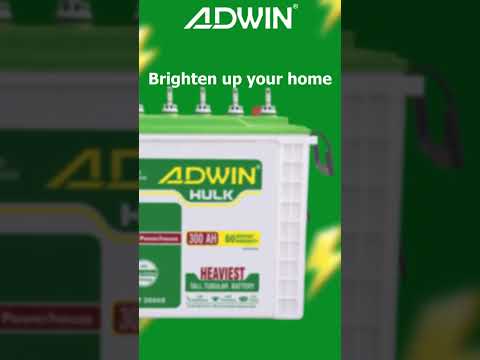
Trust the backup of Adwin #inverterbatteries to keep your home bright #Adwin #adwinbatteries
Employee Engagement at ADWIN Batteries | Life at ADWIN
बढ़ते बिजली बिल से परेशान? Solar Panel से करें Bill कम | Adwin Power Solar Solution

Adwin Power Meet 2026
Tired of sudden power cuts disrupting your daily life?

Welcome to ADWIN | Employee Induction Program Highlights

Ever wondered what goes behind the making of a reliable battery?

Big Match Tonight? Zero Power Cuts Allowed! ⚽🔋 | Adwin Bheem Inverter Battery

Safety Engineering Training Program at ADWIN
Adwin Solar Batteries | Top-notch solar batteries for maximizing savings
Adwin Inverter Battery | Best Inverter Battery #battery #inverterbattery #Shorts #india
Adwin inverter batteries | Best battery for long lasting performance | Adwin Customer Testimonial
Adwin Batteries: Powering Through Power Cuts, Uninterrupted Life Every Day!

Tap into the sun’s power, boost your savings, & enjoy uninterrupted workflow with Solar Battery.
Adwin Battery at EV EXPO, New Delhi



.jpeg)
.jpeg)


.jpeg)


.jpeg)


