3kW Solar Panel Price in India: Cost, Subsidy and Output


A 3kW solar panel system in India costs between ₹1.6 lakh and ₹2.1 lakh installed in 2026, before any government support. Under the PM Surya Ghar Muft Bijli Yojana, residential buyers can claim ₹78,000 as a direct benefit transfer, bringing the net cost down to approximately ₹82,000 to ₹1.32 lakh. At this net price, most 3 BHK homes recover the investment in 4 to 5 years.
Prices above are indicative for 2026 and vary by state, panel technology, and installer. Verify at purchase.
3kW Solar System: Cost, Subsidy and Output Summary
Parameter | Typical Value |
|---|---|
System cost (before subsidy) | ₹1.6 – ₹2.1 lakh |
PM Surya Ghar subsidy | ₹78,000 (for on-grid and hybrid systems) |
Net cost after subsidy | ₹82,000 – ₹1.32 lakh |
Daily generation | 12 – 15 units |
Monthly generation | 360 – 450 units |
Roof space required | 270 – 300 sq. ft. (shadow-free) |
Payback period | 4 – 5 years |
System lifespan | 20 – 25 years |
3kW Solar Panel Price in India with Subsidy: How the Numbers Work
The PM Surya Ghar Muft Bijli Yojana uses a tiered subsidy structure. For a 3kW system, the calculation is:
- First 1kW: ₹30,000
- Second 1kW: ₹30,000
- Third 1kW: ₹18,000
- Total subsidy: ₹78,000
This is also the maximum subsidy available under the scheme. Installing a 5kW system does not get you more subsidy, it is capped at ₹78,000 regardless of system size (up to 10kW residential limit).
The subsidy is credited directly to your bank account 30 to 45 days after your DISCOM (electricity distribution company) conducts a site inspection and verifies the installation. You pay the installer the full cost upfront (or via a loan), and the subsidy arrives later.
Important conditions (verify at the time of application on pmsuryaghar.gov.in):
- Must be a residential rooftop installation
- Panels must be ALMM-listed (domestically manufactured, approved by MNRE)
- Inverter must be BIS-certified
- Installer must be MNRE-empanelled
- You must have an active electricity connection from your DISCOM
Off-grid systems do not qualify for the subsidy. Only on-grid and hybrid systems are eligible.
3kW Solar System Price by Type
System Type | Approx. Cost (Before Subsidy) | Subsidy Eligible | Net Cost (After Subsidy) |
|---|---|---|---|
On-grid | ₹1.60 – ₹1.80 lakh | Yes | ₹82,000 – ₹1.02 lakh |
Hybrid (with battery) | ₹2.10 – ₹2.70 lakh | Yes (panels and inverter only) | ₹1.32 – ₹1.92 lakh |
Off-grid | ₹2.20 – ₹2.50 lakh | No | Full cost applies |
On-grid systems are the cheapest because they have no battery. Surplus generation goes back to the grid through net metering and is credited against your electricity bill. If your area has stable grid power, on-grid is the better value choice for most buyers.
Hybrid systems add a battery, which means power during grid outages. The battery is the most expensive component and adds ₹50,000 to ₹90,000 depending on chemistry and capacity.
What Does a 3kW Solar System Actually Run?
A 3kW system generating 12 to 15 units per day can typically cover:
- 4 to 6 ceiling fans
- 8 to 10 LED lights
- 1 refrigerator (200–250 litre)
- 1 washing machine (used occasionally)
- 1 television
- 1 water pump (1HP, used briefly)
- 1.5-ton air conditioner for 2 to 3 hours per day
This is a reasonable match for a 2 BHK to 3 BHK home with moderate electricity consumption. If you run multiple ACs simultaneously or have a larger home, a 5kW system is a better fit.
Solar generation varies by season. Summer months (March to May) yield the highest output, up to 15 units per day in north India. Monsoon months typically drop to 7 to 9 units per day in regions with heavy cloud cover.
Adwin's solar power systems range covers complete residential and commercial setups if you want to compare configurations.
Component Breakdown: Where Your Money Goes
Component | Share of Total Cost |
|---|---|
Solar panels | 50 – 55% |
On-grid or hybrid inverter / Solar PCU | 20 – 25% |
Mounting structure and hardware | 10 – 12% |
DC and AC wiring, protection devices | 8 – 10% |
Installation and commissioning | 5 – 8% |
Panel quality is where most of the cost variation lies. A Mono PERC or TOPCon N-type panel costs more per watt than a standard P-type panel but generates more power from the same roof area. In a space-constrained installation, the efficiency premium pays off. In an open installation with plenty of roof space, the cheaper panel often makes more financial sense.
For solar systems requiring reliable battery storage, particularly hybrid and off-grid setups, pairing with a quality Solar PCU inverter and charger ensures efficient charge management between panels, battery, and grid.
Honest Pros and Cons of a 3kW Solar System
Pros:
- Maximum subsidy percentage: ₹78,000 covers roughly 47% of a ₹1.65 lakh system
- Monthly savings of ₹2,000 to ₹4,000 on electricity bills (verify against your current tariff)
- Payback in 4 to 5 years, then largely free power for 15 to 20 more years
- Reduces carbon output by approximately 4 to 5 tonnes of CO2 per year
Cons and realities:
- You pay the full cost upfront (or take a loan), the subsidy arrives 30 to 45 days later
- On-grid systems provide no backup during power cuts (the inverter shuts off automatically when the grid goes down, for safety)
- Requires 270 to 300 sq. ft. of shadow-free south-facing roof space
- DISCOM approval timelines vary by state, some take a few weeks, others several months
- If electricity tariffs are subsidised in your state, the payback period is longer
Who Should Buy a 3kW System
Strong fit:
- Homeowners in states with relatively high electricity tariffs (Maharashtra, Karnataka, Tamil Nadu, Delhi)
- 2 BHK to 3 BHK homes with monthly bills of ₹2,000 to ₹4,000
- Anyone who wants to maximise the PM Surya Ghar subsidy percentage
Marginal fit:
- Homes with heavy AC usage (consider 5kW instead)
- Buyers who want battery backup during power cuts, the on-grid system does not provide this; a hybrid does but at higher cost
Not a fit:
- Renters (subsidy requires property ownership and DISCOM connection in your name)
- Homes with heavy shading or north-facing roofs
FAQs: 3kW Solar Panel Price in India
What is the 3kW solar panel price in India with subsidy in 2026?
A 3kW on-grid solar system costs ₹1.6 to ₹2.1 lakh before subsidy. After the ₹78,000 PM Surya Ghar subsidy, the net cost typically falls between ₹82,000 and ₹1.32 lakh. The 3kW solar system price in India with subsidy is lower as a percentage of total cost than any larger system size, making it the best subsidy-to-investment ratio available. Prices vary by state, panel technology, and installer.
How much electricity does a 3kW solar system produce per day?
A 3kW solar system generates approximately 12 to 15 units per day in good sunlight conditions. Monthly generation is typically 360 to 450 units, which offsets 60 to 80% of a typical 3 BHK home's electricity consumption.
What is the PM Surya Ghar subsidy for a 3kW system?
The PM Surya Ghar Muft Bijli Yojana provides ₹78,000 for a 3kW residential on-grid or hybrid solar system. This is calculated as ₹30,000 for the first kW, ₹30,000 for the second kW, and ₹18,000 for the third kW. The subsidy is the same for any system 3kW and above (up to 10kW residential limit). Verify current subsidy terms at pmsuryaghar.gov.in before applying.
Does a 3kW solar system work during power cuts?
An on-grid 3kW system shuts off automatically during power cuts for safety reasons. A hybrid system with a battery bank continues to supply power during outages. If backup during power cuts is important to you, budget for the hybrid configuration.
How much roof space does a 3kW solar system need?
A 3kW system requires roughly 270 to 300 square feet of shadow-free roof space, typically accommodating 6 to 8 solar panels depending on the wattage per panel.
What is the payback period for a 3kW solar system in India?
With the PM Surya Ghar subsidy applied, most homeowners recover their net investment in 4 to 5 years through electricity bill savings. After payback, the system generates near-free power for another 15 to 20 years.
Is a 3kW solar system enough for a 2 BHK or 3 BHK home?
A 3kW system is generally sufficient for a 2 BHK to 3 BHK home with moderate electricity use, fans, lights, a refrigerator, a TV, and a washing machine. If you run one 1.5-ton AC for a few hours daily, the system can still manage. For heavier AC usage or a 4 BHK home, consider a 5kW system.
Can I get a loan for a 3kW solar system under PM Surya Ghar?
Yes. The PM Surya Ghar scheme includes provisions for collateral-free solar loans through nationalised banks at concessional interest rates. SBI's solar loan under this scheme is available at around 7% per annum (verify current rates at your bank or pmsuryaghar.gov.in before applying).
Featured Videos
Watch insightful guides and product highlights
Build a greener tomorrow by choosing solar power
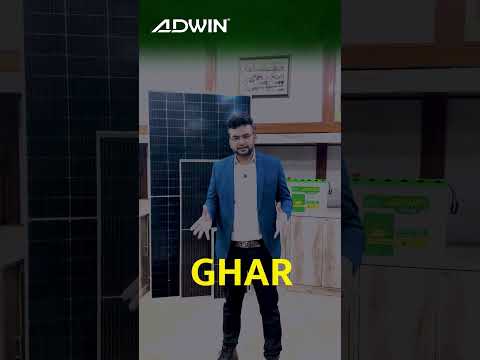
बढ़ते बिजली बिल से परेशान? Solar Panel से करें Bill कम | Adwin Power Solar Solution
Adwin Solar Batteries | Top-notch solar batteries for maximizing savings



.jpeg)


.jpeg)


.jpeg)
.jpeg)


